Mango Strawberry Sorbet
Mango Strawberry Sorbet: The Ultimate Refreshing Summer Dessert
Introduction to the Magic of Homemade Sorbet
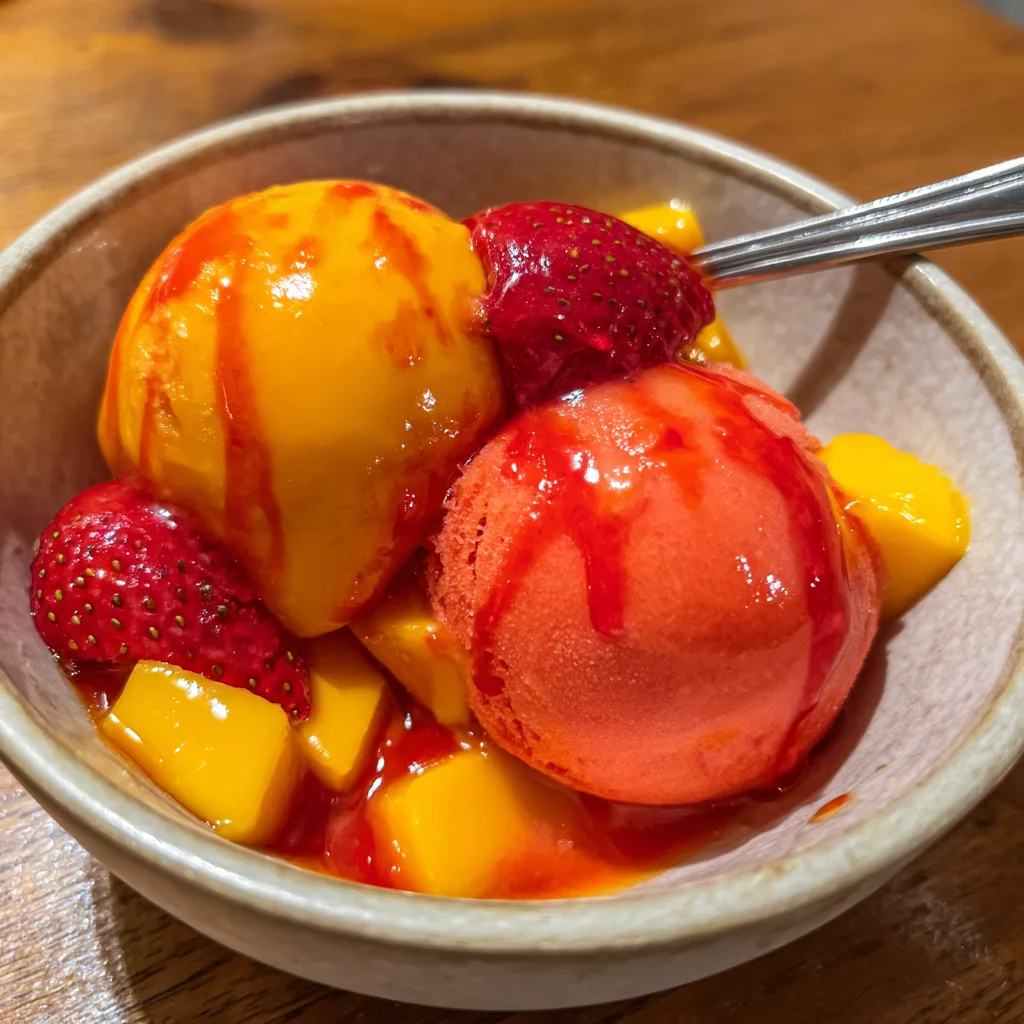
When the temperature rises and the summer sun beats down relentlessly, there are few culinary experiences more satisfying and revitalizing than a scoop of icy, fruit-packed sorbet. While ice creams and gelatos are beloved for their rich, heavy, and creamy profiles, sorbet offers an entirely different kind of indulgence. It is light, intensely flavorful, remarkably refreshing, and entirely dairy-free. Among the endless pantheon of fruit flavor combinations, the Mango Strawberry Sorbet stands out as a true masterpiece of balance, color, and taste.
The beauty of this vibrant, coral-pink and golden-orange dessert lies in its absolute purity. It does not hide behind heavy creams, egg yolks, or complex custard bases. Instead, it places the raw, natural brilliance of fresh summer fruits on a pedestal. This dessert captures the essence of a tropical getaway and a classic backyard garden harvest, blending the exotic, velvety sweetness of ripe mangoes with the familiar, tart, and juicy burst of fresh strawberries. In this comprehensive guide, we will explore everything from the fascinating ancient history of sorbet to the precise food science required to achieve a flawlessly smooth texture in your very own kitchen. Get ready to ditch the store-bought pints forever and embrace the vibrant world of homemade fruit sorbet.
The Ancient and Fascinating History of Sorbet
To truly appreciate the elegant simplicity of a Mango Strawberry Sorbet, it is highly rewarding to look back at the rich history of frozen desserts. Sorbet is, in fact, the oldest known form of frozen dessert, predating dairy-based ice cream by centuries, if not millennia. The origins of sorbet can be traced back to the ancient Middle East. The word “sorbet” itself is derived from the Arabic word “sharbat,” which originally referred to a sweet, chilled, fruit-based beverage. These early sharbats were often made with fruit juices, flower petals (like rose or hibiscus), and honey, cooled with snow harvested from high mountain peaks and preserved in deep, insulated underground caverns known as yakhchals.
As trade routes expanded, this concept of sweet, iced fruit drinks traveled to Europe, particularly to Italy and France, via the Mediterranean. Historical legends often credit Marco Polo with bringing techniques for making fruit ice from Asia back to Venice, though historians debate the exact timeline. By the 16th and 17th centuries, the European nobility had become obsessed with “water ices.” The French refined the technique, evolving the drinkable sharbat into the scoopable, soft-frozen dessert we now recognize as “sorbet.” Today, we continue this ancient culinary tradition, swapping the hand-harvested mountain snow for modern freezers, but maintaining the pure, fruit-forward spirit of those original ancient delicacies.
Why Mango and Strawberry are the Perfect Flavor Pairing
Creating a truly memorable sorbet requires more than just freezing fruit puree; it requires a thoughtful pairing of flavors and textures. The combination of mango and strawberry is not just visually stunning—resulting in a gorgeous, sunset-hued dessert—but it is also a scientifically and culinarily perfect match.
The Role of the Mango: Mangoes are often referred to as the “king of fruits,” and for good reason. They boast a deep, honey-like sweetness and a complex, slightly floral aroma. More importantly for sorbet making, mangoes are incredibly rich in naturally occurring pectin and soluble fiber. Pectin acts as a natural stabilizer and thickener. When pureed and frozen, the pectin in the mango prevents the sorbet from turning into a solid, icy brick, giving the final dessert a remarkably creamy, almost gelato-like mouthfeel, despite containing absolutely zero dairy.
The Role of the Strawberry: If the mango provides the creamy base and floral sweetness, the strawberry brings the necessary acidic punch. Strawberries are inherently bright, tart, and highly acidic. This acidity is crucial because freezing dulls the human palate’s perception of flavor. A dessert that tastes perfectly sweet at room temperature will taste bland when frozen. The sharp, vibrant acidity of the strawberries cuts through the heavy sweetness of the mango, awakening the taste buds and ensuring that every spoonful is exceptionally refreshing and balanced.
The Science of Sorbet: Achieving the Perfect Texture
Making sorbet might seem as simple as blending fruit and putting it in the freezer, but there is a delicate food science at play. The goal of any sorbet is to create the smallest possible ice crystals. Large ice crystals result in a gritty, hard, and unpleasant texture (like a frozen block of juice), while microscopic ice crystals result in a smooth, luxurious, scoopable dessert.
The Importance of Sugar: Sugar in a sorbet recipe is not just for sweetness; it is a critical structural ingredient. Sugar acts as an antifreeze. It lowers the freezing point of the water naturally present in the fruit juice. By lowering the freezing point, the sugar prevents the water molecules from locking together into a solid block of ice, keeping the mixture soft enough to scoop. If you reduce the sugar too much in an attempt to make it “healthier,” you will inevitably end up with a rock-hard dessert.
The Magic of Agitation: While you can make a “no-churn” sorbet by simply freezing the puree, using an ice cream maker yields superior results. An ice cream maker simultaneously freezes the mixture while continuously churning (agitating) it. This constant movement physically breaks up ice crystals as they form, forcing them to remain microscopic and resulting in a professional-quality, silky-smooth texture.
Deep Dive into the Ingredients
Because this Mango Strawberry Sorbet relies on so few ingredients, the quality of those components is paramount. Let’s look closely at what you need.
The Mangoes
For the best flavor and texture, use Ataulfo (often called Champagne or Honey mangoes) or Kent mangoes. These varieties are incredibly sweet, exceptionally smooth, and not stringy or fibrous like Tommy Atkins mangoes can be. If you cannot find good quality fresh mangoes, high-quality frozen mango chunks are an excellent, convenient alternative, as they are picked and flash-frozen at peak ripeness.
The Strawberries
Fresh, seasonal strawberries that are bright red all the way through will yield the most vibrant color and flavor. Look for berries that are fragrant—if they don’t smell like strawberries in the store, they won’t taste like much in your sorbet. Just like the mangoes, frozen strawberries can absolutely be used if fresh ones are out of season.
The Simple Syrup (Sugar and Water)
Instead of just dumping granulated sugar into the fruit puree (which can result in a grainy texture if it doesn’t dissolve completely), we use a simple syrup—a mixture of equal parts water and sugar heated until the sugar is dissolved. This ensures perfectly even distribution of the sugar throughout the sorbet base.
Fresh Lime Juice
A splash of fresh citrus is the secret ingredient that professional chefs use to make fruit flavors “pop.” The lime juice enhances the natural tartness of the strawberries and balances the heavy sweetness of the syrup and mango. Never use bottled lime juice; the fresh oils from the zest and the bright acidity of the freshly squeezed juice are essential.
Ingredients List
Gather these simple ingredients to create your vibrant summer dessert:
- – 2 cups fresh or frozen mango chunks (about 2 large mangoes)
- – 2 cups fresh or frozen strawberries, hulled and halved
- – 3/4 cup granulated sugar
- – 3/4 cup water
- – 2 tablespoons fresh lime juice (about 1 medium lime)
- – 1 small pinch of salt (to enhance flavors)
- – Extra fresh fruit for garnishing
Step-by-Step Instructions
Follow these precise steps to ensure your sorbet turns out perfectly smooth and flavorful:
- Make the Simple Syrup: In a small saucepan over medium heat, combine the granulated sugar and water. Stir gently until the sugar is completely dissolved and the liquid is clear. Bring it to a gentle simmer for 1 minute, then remove from heat. Transfer the syrup to a heat-proof container and place it in the refrigerator until completely chilled. Do not mix hot syrup with your fruit!
- Prepare the Fruit: If using fresh fruit, peel and dice the mangoes, and wash, hull, and halve the strawberries. If using frozen fruit, allow it to thaw slightly at room temperature for about 15 minutes so it is easier to blend.
- Blend the Base: Place the mango chunks, strawberries, fresh lime juice, the pinch of salt, and the completely chilled simple syrup into a high-powered blender or a large food processor.
- Puree Until Silky: Blend the mixture on high speed until it is entirely smooth and completely liquefied. There should be no visible chunks of fruit. For an ultra-refined, restaurant-quality texture, you can pass this puree through a fine-mesh sieve or strainer to remove the tiny strawberry seeds, though this step is completely optional.
- Chill the Base (Crucial Step): Even if your syrup was cold, the friction from the blender will have warmed the puree. Pour the fruit mixture into a bowl, cover it, and place it in the refrigerator for at least 2 to 4 hours. The mixture must be extremely cold (around 40°F/4°C) before churning to ensure small ice crystals.
- Churn the Sorbet: Pour the chilled fruit base into your ice cream maker. Churn according to the manufacturer’s instructions. This usually takes between 15 and 25 minutes. The sorbet is ready when it reaches the consistency of thick, soft-serve ice cream.
- Freeze to Set: Transfer the soft-churned sorbet into a shallow, freezer-safe, airtight container. Smooth the top with a spatula. Press a piece of wax paper or parchment paper directly against the surface of the sorbet to prevent ice crystals from forming. Freeze for at least 4 hours, or overnight, until firm enough to scoop.
- Serve and Enjoy: Remove the sorbet from the freezer about 5 to 10 minutes before serving to let it soften slightly for easier scooping. Garnish with fresh fruit and enjoy!
No-Churn Alternative Method
If you do not own an ice cream maker, you can still make this delicious treat! Follow the recipe through step 4. Pour the puree into a shallow metal baking pan and freeze for 45 minutes. Remove from the freezer and vigorously stir with a fork, scraping the frozen edges into the center to break up ice crystals. Repeat this freezing and scraping process every 30 minutes for about 3 to 4 hours, until the mixture is firm and scoopable.
Pro Tips for the Best Homemade Sorbet
Elevate your dessert game with these insider tips:
The Egg Float Test: How do you know if you have the perfect sugar-to-fruit ratio? Wash a raw egg in the shell. Drop it into your pureed (unchilled) sorbet base. If the egg sinks completely, you need more sugar. If it floats high above the surface, it is too sweet. The perfect base will allow a dime-sized circle of the eggshell to show above the surface of the liquid. Remove the egg before chilling!
The Alcohol Trick: Adding 1 to 2 tablespoons of neutral alcohol, like vodka, to your sorbet base before churning works wonders. Alcohol does not freeze at standard home freezer temperatures, so it acts as an additional antifreeze, keeping your sorbet incredibly soft and easy to scoop straight from the freezer. Because the amount is so small, you will not taste it.
Fun Variations and Customizations
The mango-strawberry base is highly versatile. Try these exciting twists:
Tropical Herb: Add a handful of fresh basil leaves or fresh mint leaves to the blender when pureeing the fruit. The herbaceous notes pair gorgeously with the sweet tropical fruit.
Spicy Kick: If you love a sweet and spicy combination, add a dash of cayenne pepper or a teaspoon of Tajín seasoning to the base. It is a fantastic Mexican-inspired twist that highlights the mango beautifully.
Coconut Swirl: For a creamy, vegan twist, swirl in a few tablespoons of sweetened condensed coconut milk right before the final freeze.
Serving Suggestions
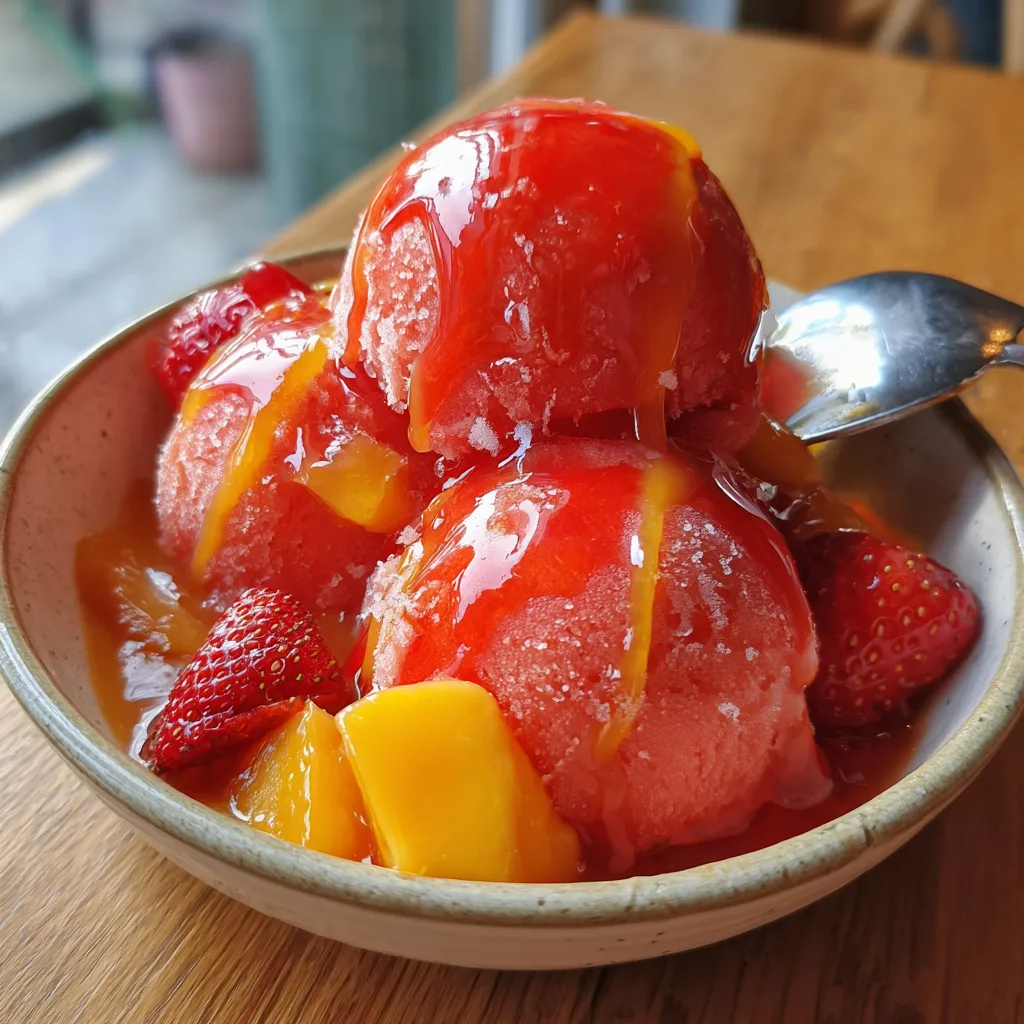
This sorbet is elegant enough to be served simply on its own in chilled glass coupes or ceramic bowls. Garnish heavily with fresh, diced mangoes, sliced strawberries, and perhaps a sprig of fresh mint.
For a fun, kid-friendly presentation, scoop it into crisp waffle cones or sugar cones. It also makes an exceptional palate cleanser between heavy savory courses at an elegant dinner party. You can even use a scoop of this sorbet as a base for a summery mocktail or cocktail—pour a little sparkling water, prosecco, or champagne over a scoop in a tall glass for an instant, beautiful beverage.
Storage and Freezer Burn Prevention
Homemade sorbet does not contain the commercial chemical stabilizers that store-bought brands use, which means it is more susceptible to icy textures over time. Store your sorbet in a shallow, wide, airtight container rather than a deep one; this allows it to freeze and thaw more evenly. Always keep a piece of parchment paper or plastic wrap pressed directly against the surface of the frozen sorbet to block out air and prevent freezer burn. For the absolute best flavor and texture, consume your homemade sorbet within 1 to 2 weeks.
Conclusion
Making a Mango Strawberry Sorbet from scratch is a highly rewarding culinary endeavor that yields a dessert far superior to anything you can buy in a carton. By understanding the simple science of fruit, sugar, and cold temperatures, you can capture the essence of summer in a bowl. Its brilliant color, intense fruit flavor, and refreshing qualities make it the ultimate warm-weather treat. Gather your fresh fruits, fire up your blender, and treat yourself to the purest, most delicious dairy-free dessert you will ever experience!
Mango Strawberry Sorbet
Ingredients
Equipment
Method
- In a small saucepan, heat the sugar and water over medium heat, stirring until the sugar is fully dissolved. Chill this simple syrup in the fridge.
- In a blender, combine the mango chunks, strawberries, chilled simple syrup, fresh lime juice, and a pinch of salt.
- Blend on high until completely smooth and liquefied.
- Chill the pureed fruit mixture in the refrigerator for at least 2 hours until very cold.
- Pour the chilled base into an ice cream maker and churn for 15-25 minutes according to manufacturer instructions until it reaches soft-serve consistency.
- Transfer the sorbet to an airtight container, press parchment paper against the surface, and freeze for at least 4 hours until firm.