Easy Crochet Table Runner Pattern: Sage Medallion Lace
📖 B. INTRODUCTION
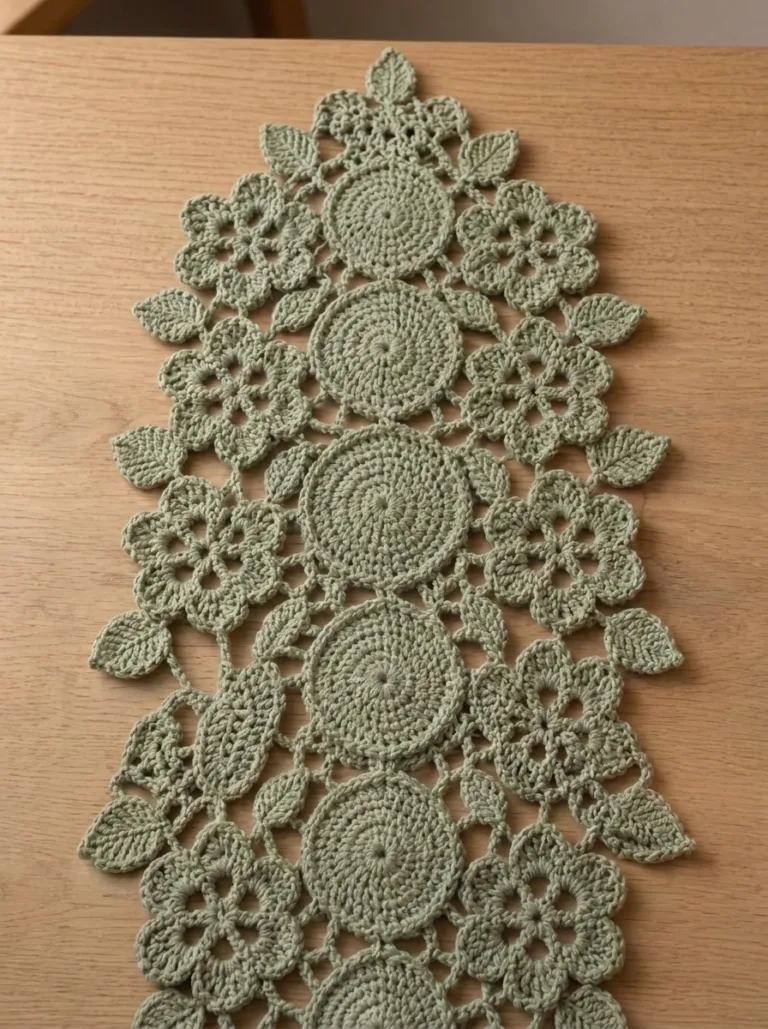
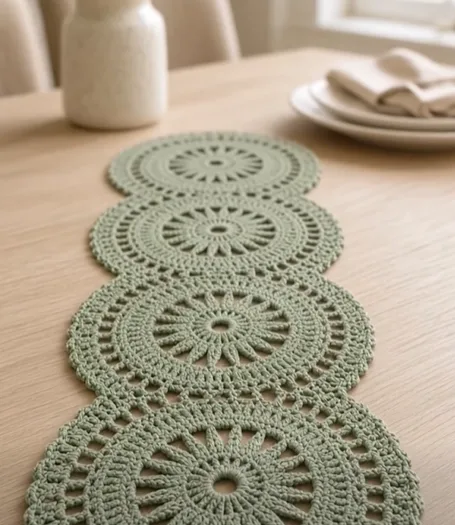
Bring a breath of fresh air to your dining room with this elegant Sage Medallion Lace table runner pattern. Inspired by modern minimalist design, this piece features a striking row of large, identical circular motifs joined in a single, sweeping line. The design pairs a calming, solid sage green colorway with open, airy lacework, creating a beautiful contrast that lets the surface of your table peek through.
This project is wonderfully meditative and highly rewarding. Because it is constructed from repeated circular medallions, it is the perfect portable project to take on the go. You can crochet the individual circles separately and seam them together at the very end, or use a clever Join-As-You-Go (JAYG) method for a seamless finish.
Whether you are dressing up a light wood dining table for a spring brunch, laying it across a bedroom dresser, or gifting it for a housewarming, this pattern is incredibly adaptable. By simply adding or subtracting medallions, you can customize the length to perfectly fit any surface in your home.
🔍 C. MAIN PATTERN OVERVIEW
This runner relies on a highly modular construction. The core design consists of identical large circular medallions. Each medallion begins with a distinct open center ring, radiating outward into a sunburst of long petal-like stitches. This floral center is then framed by a solid band of stitches and finished with an outer border of delicate chain-space loops.
Once all your medallions are crocheted, they are aligned point-to-point in a straight line. They are joined at two specific chain loops to create a secure, flat connection that prevents the runner from shifting or twisting out of shape. The monochromatic sage green palette ensures that the intricate stitch texture remains the star of the show.
🎯 D. SKILL LEVEL
Easy / Advanced Beginner
This pattern is very accessible for crocheters who have mastered the basics and are comfortable working in the round.
Techniques Involved:
- Working into a foundation chain ring
- Double crochet (dc) and Treble crochet (tr)
- Working into chain spaces (ch-sp)
- Keeping track of stitch counts in concentric circles
- Basic whipstitch joining (or optional Join-As-You-Go slip stitches)
📏 E. FINISHED SIZE
- Medallion Diameter: Each blocked circle measures approximately 9.5 inches (24 cm) across.
- Total Runner Width: 9.5 inches (24 cm).
- Total Runner Length (4 Medallions): Approximately 38 inches (96.5 cm).
- Note: The length is completely customizable. A standard 6-foot dining table usually looks best with a 5 to 6-medallion runner, while a shorter console table may only need 3.
🧮 F. GAUGE
- First 3 Rounds of Medallion: Measures exactly 3.5 inches (9 cm) in diameter.
- Note: While exact gauge isn’t as crucial as it is for a garment, keeping your tension consistent across all your medallions ensures they are exactly the same size, which is critical for a straight, flat runner.
🧶 G. REQUIRED YARN AMOUNTS
Estimates are based on a 4-medallion runner using #4 Worsted Weight / Aran cotton yarn.
- Total Yarn Required: Approximately 380 – 420 yards (347 – 384 meters) of a solid Sage Green cotton yarn.
- Planning to make it longer? Estimate about 95-105 yards per additional medallion.
🧰 H. MATERIALS
- Hook: US G/6 (4.0 mm) crochet hook (or size needed to meet gauge).
- Yarn: #4 Worsted Weight 100% Cotton Yarn. Cotton is highly recommended over acrylic for table linens because it lies flat, absorbs condensation, and handles heat from serving dishes beautifully.
- Tapestry Needle: For weaving in ends and seaming.
- Scissors: Sharp craft snips.
- Blocking Supplies: A spray bottle (or steam iron), rust-proof T-pins, and a blocking mat are highly recommended to open up the lacework.
🔤 I. ABBREVIATIONS – US TERMS
- ch – chain
- sl st – slip stitch
- sc – single crochet
- dc – double crochet
- tr – treble crochet
- st(s) – stitch(es)
- sp(s) – space(s)
- MR – magic ring
- sk – skip
📝 J. NOTES BEFORE YOU BEGIN
- Turning: Do not turn your work at the end of a round. The right side (RS) of the work will always face you.
- Starting Chains: The initial chains at the beginning of a round count as a stitch where indicated.
- Cotton Yarn Behavior: Cotton yarn has very little stretch. If your hands get tired, take breaks! The stiffness of the cotton is exactly what gives this lace its beautiful, crisp definition.
- Join-As-You-Go (JAYG): If you are an experienced crocheter, you can join the medallions on the fly during Round 8 by substituting a slip stitch into the adjacent medallion’s chain loop instead of completing a full chain-4. For simplicity, this pattern provides the whipstitch method in the assembly section.
🪡 K. COMPLETE PATTERN
🟢 The Medallion (Make 4)
The entire runner is built from these identical circular motifs. They feature an open center, petal-like spokes, and a looped border.
Starting Point: The center ring. Yarn Color: Sage Green.
Foundation Ring: Ch 8, sl st into the first ch to form a large open ring.
Round 1: Ch 3 (counts as 1 dc). Work 23 dc into the center of the ring. Sl st to the top of the beginning ch-3 to join. (24 dc)
Round 2 (Creating Spoke Bases): Ch 4 (counts as 1 dc + ch 1). Sk 1 st, 1 dc in next st, ch 1. Repeat from * around. Sl st into the 3rd ch of the starting ch-4 to join. (12 dc, 12 ch-1 sps)
Round 3 (The Sunburst Petals): Sl st into the first ch-1 sp. Ch 4 (counts as 1 tr). Work 2 tr into the same ch-1 sp. Ch 2. Work 3 tr into the next ch-1 sp, ch 2. Repeat from * around. Sl st to the top of the starting ch-4 to join. (12 3-tr petal groups, 12 ch-2 sps)
Round 4 (Anchoring the Petals): Ch 1. 1 sc in each of the next 3 tr sts, 2 sc in the ch-2 sp. Repeat from * around. Sl st to the first sc to join. (60 sc)
Round 5 (Solid Band): Ch 3 (counts as 1 dc). 1 dc in each st around. Sl st to the top of the starting ch-3 to join. (60 dc)
Round 6 (Solid Band Increase): Ch 3 (counts as 1 dc). 1 dc in the next 8 sts, 2 dc in the next st (increase made). 1 dc in the next 9 sts, 2 dc in the next st. Repeat from * around. Sl st to the top of the starting ch-3 to join. (66 dc)
Round 7 (Mesh Base): Ch 4 (counts as 1 dc + ch 1). Sk 1 st, 1 dc in the next st, ch 1. Repeat from * around. Sl st to the 3rd ch of the starting ch-4 to join. (33 dc, 33 ch-1 sps)
Round 8 (Outer Loop Border): Sl st into the first ch-1 sp. Ch 1, 1 sc in the same sp. Ch 4, sk the next dc and the next ch-1 sp, 1 sc in the next dc. Ch 4, sk the next ch-1 sp and the next dc, 1 sc in the next ch-1 sp. Ch 4, sk the next dc and the next ch-1 sp, 1 sc in the next dc. Repeat this pattern around to create a continuous scalloped edge of loops. Sl st to the first sc to join. (33 ch-4 loops)
Fasten off and weave in both the starting and ending tails securely on the wrong side of the work.
🎨 L. STYLING / ASSEMBLY / STABILITY / FINAL SHAPING
Because lace can look crumpled right off the hook, proper finishing is essential for this design to look elegant and modern.
1. Blocking (Do this BEFORE joining):
- Soak your medallions in cool water (or pin them down dry and spray them heavily with water).
- Pin them to a blocking mat, gently stretching them into perfect circles. Ensure all the Round 8 chain loops are pinned outward so they dry crisp and open.
- Let them dry completely. This step ensures all medallions are identically sized, making joining effortless.
2. Assembly:
- Lay your 4 blocked medallions out in a single straight line on a flat surface, with the Right Sides facing up.
- Identify the two adjacent ch-4 loops where the first two medallions touch.
- Cut a 10-inch length of Sage Green yarn and thread your tapestry needle.
- Whipstitch the two touching loops of Medallion 1 to the two touching loops of Medallion 2. Sew tightly, weaving the ends securely into the solid dc rounds (Round 6) below the loops to hide the tails.
- Repeat this process down the line, ensuring you are joining at directly opposing points so the runner stays perfectly straight.
3. Final Styling Check: ✅ Ensure the center rings are perfectly aligned down the center of the table. ✅ Verify that the runner lies completely flat without buckling at the seams. ✅ Style on a clean, light wood or neutral-toned table to allow the sage green and open lace patterns to pop.
💡 M. HELPFUL CROCHET TIPS
- 💡 Counting is Key: Pay close attention to the stitch counts on Rounds 4 and 6. If the solid rounds are off by even one stitch, the final loop border (Round 8) will not align correctly.
- 💡 Seamless Color: If you decide to make this in multiple colors (e.g., a cream center with sage borders), always execute your color change on the final pull-through of the slip stitch that ends the previous round.
- 💡 Hiding Ends in Lace: Lace patterns have fewer solid spaces to hide yarn tails. Always weave your ends into the dense sc and dc rounds (like Rounds 4, 5, or 6), threading back and forth at least three times to lock them in.
- 💡 Tension Check: If your medallion is rippling like a potato chip during Round 6, your tension is too loose. Try dropping down half a hook size. If it is curling into a bowl, your tension is too tight; try going up half a hook size.
🧼 N. CARE INSTRUCTIONS
- Washing: 100% cotton can be machine washed, but to preserve the delicate joining seams, hand washing in cool water with a mild detergent is highly recommended.
- Drying: Never put crochet lace in the dryer. Roll the wet runner in a dry towel and press firmly to remove excess water. Lay flat to dry.
- Ironing: If the edges begin to curl after washing, place a damp cloth over the runner and press lightly with a steam iron set to the “Cotton” setting. Do not iron directly on the yarn without a protective cloth.
❓ R. FAQ
❓ Can I use acrylic yarn instead of cotton?
While you can use acrylic, it is not recommended for this specific project. Acrylic does not block well, meaning your lace loops will likely stay curled and won’t achieve the crisp, modern look of the original design. Acrylic can also melt slightly under hot plates.
❓ How do I make the runner longer without it looking flimsy?
Because the runner is modular, you can add as many medallions as you like! The structural integrity comes from a tight, secure seam at the joining loops. As long as your seams are tight and well-woven, a 10-medallion runner will be just as stable as a 3-medallion runner.
❓ My medallions are all slightly different sizes. What did I do wrong?
This usually happens when your tension naturally tightens or loosens depending on your mood or how tired your hands are. Blocking them aggressively can usually fix minor size discrepancies. Next time, try to crochet all the medallions over a similar timeframe to keep your tension consistent.
❓ Can I join them in a rectangle instead of a straight line?
Yes! By joining the medallions in a 2×3 or 3×4 grid (seaming them at 4 points instead of 2), you can easily turn this table runner pattern into a stunning rectangular tablecloth or placemat set.